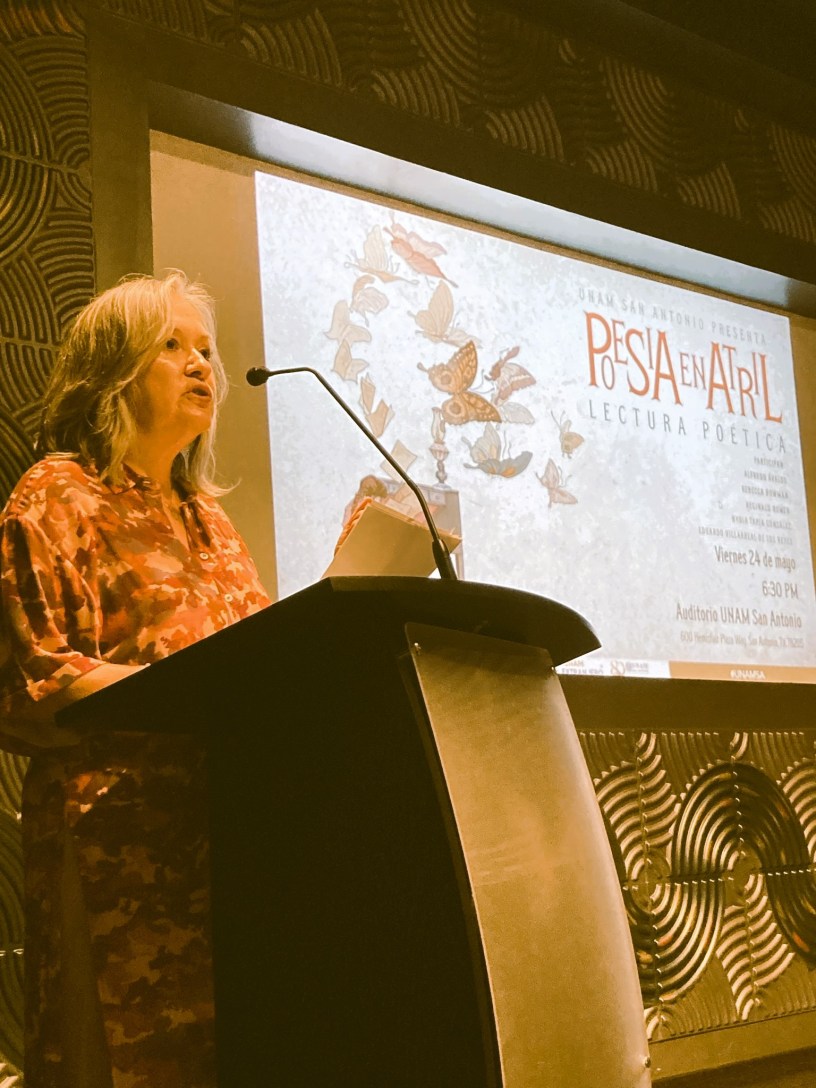
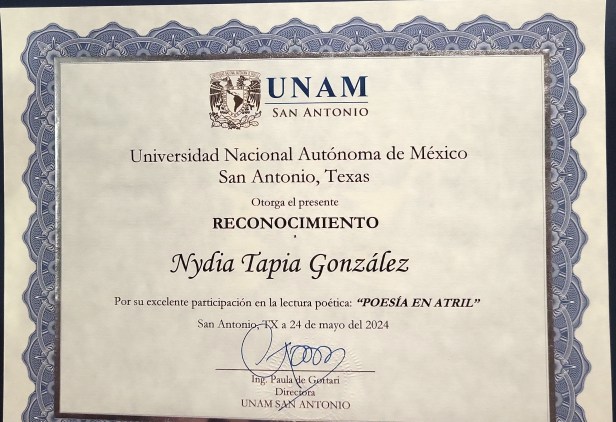
This past Memorial weekend, I had the opportunity to present four of my poems at the Universidad Nacional Autónoma de México’s campus in San Antonio (UNAM SA). I just uploaded an article in Spanish that shares one of the poems I presented in Spanish.
I was invited to participate by Eduardo Villarreal de los Reyes, a poet from Matamoros and the director of Poesía en Atril, a monthly poetry reading held every first Friday in downtown Brownsville’s Hueso del Fraile. With its bohemian atmosphere, the “Hueso” is the ideal venue for poetry readings. Eduardo invites writers, poets, musicians, and singers. It is well worth a visit.
I presented two poems in Spanish and two in English. It was very special to me for UNAM, the oldest university in Mexico, founded on September 21, 1551. It is the largest and most important university in Mexico and Ibero-America.
In 1944, UNAM extended its presence beyond the national borders to the United States thanks to the continuous support of the San Antonio community and the Mexican government. English and Spanish are taught there, among other courses. To learn more, visit unamsa.edu.
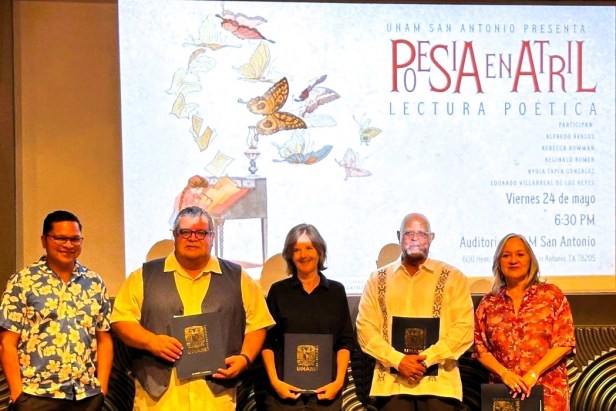
The evening’s presenters included Alfredo Avalos, Rebecca Bowman, Reginald Romer, Eduardo Villarreal de los Reyes, and me. The program consisted of poetry in Spanish, English, and Papiamentu by Reginal Romer, a professor from Curaçao. His poem in Papiamentu is available in my Spanish article here.
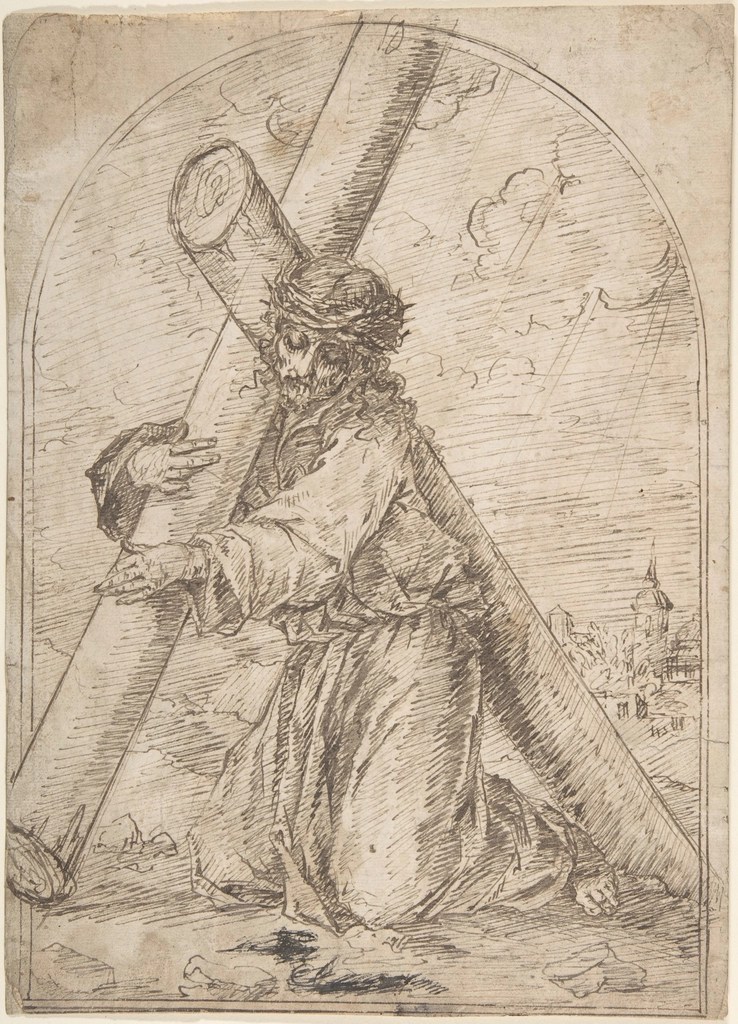
My first poem, Mexico’s Baroque Suffering, was inspired by a visit to Puebla and Morelos, Mexico, where I lost count of the many baroque-style churches we visited. I had enough and was a bit overwhelmed by blood, pain, and sadness.
The second is an ekphrastic poem titled Elixir of Gods that I presented during a Writers League of Texas retreat a few years ago. Our instructor, Poet Scott Wiggerman, selected this poem, albeit I was the least experienced of his students. I was afraid to recite this poem because of my accent, but the reaction was favorable, and I overcame the fear of sharing my inspiration. The image that inspired the poem was that of a cactus and maguey in the hot western landscape of West Texas. I thought of two older Mexican “comadritas” talking about the grandness of the past.
I sincerely hope you enjoy reading them.
Mexico’s Baroque Suffering
I cannot take one more helpless stare,
For my heart breaks
When the pain I caused stares back and
There is no redemption, no glory to be found.
*
I cannot take one more crown of thorns,
One more drop of blood,
Your ever-present passion kills me
In every wall and every niche.
*
I’ve had enough of lavishly encased relics
In this faithful land of yours
That bears pain as an amulet.
*
Last I remember you resurrected and walked
Along the Sea of Galilee.
You said you’d be with us until the end of times.
Yet we still worship you on the cross.
*
I come seeking your peace,
Your light burden and easy yoke,
But everywhere I see pain, anguish,
And blood, lots of blood.
*
Next to my bed, your image
Renders the time you walked the road to Emmaus.
The joy of a new life, a resurrection
Reflected in your sacred light.
*
Like the poet Machado, I cannot worship you on the cross
And deplore the faith of his ancestors.
But like them, I seek a ladder to climb that cross
And remove those blasphemous nails
That took your life from us.
*
Last I remember, you resurrected
And left footprints on the sand.
You said you’d be with me until the end of times
I know –
For I surrendered my boat by the shore
To follow you.
Elixir of Gods
Look at us,
we barely stand out here in the western sun
tangled in weeds and brush
our glorious past unbeknown to most.
*
Drink and delicacy of ancient royalty,
bestowers of civilized pleasures,
where did it all go?
Inglorious present in front of you.
*
My leaves provided thatch for humble dwellings,
my fibers thread and cord,
if cooked, my pulp is nutritious
You can ask the Aztecs…oh, but they’re all gone!
*
Nopal is my name of ancient heritage
comes from Nahuatl, the language of gods.
My image is revered in Mexico’s flag
and stamped in Malta’s coat of arms.
*
In Arabic, my name is patience and tenacity
qualities that survived, as you can see.
In Hebrew, I’m Sabra, a Jew born in Israel,
in Spanish, I’m peasant feed.
*
In front of you, we are all thorns
even unfriendly to most,
but if you dare look closer, you will find
our innards are sweet and moist.
 La Vida Valley | Living la Vida Local
Well done, dear friend. We are proud knowing you and all you accomplish. Also we appreciate your ole compadre and hubby, that so contributes to your so active lives together.
Larry & Crisanne
LikeLiked by 1 person